We get to know you.
Tell us where you are, what you need and where you want to go. We’ll listen before making recommendations.
 Let’s talk →
YOUR BUSINESS. OUR FOCUS.
Straightforward accountancy and proactive advice. Giving you the clarity, confidence and control to move your business forward.
◎ Based in Bristol. Working with you, wherever you are.

01 / HOW WE CAN HELP
From your first invoice to your next big decision, get the right support at the right time.
Accountancy
with a personal touch.
02 / PEOPLE BEFORE PAPERWORK
Founded by Mark Knapman, MK Accountancy Bristol Ltd is a modern accountancy firm built on trust, strong relationships and personal support for businesses and individuals.
Here at MK Accountancy, we believe accountancy should feel approachable, clear and reliable. Every client and every business is different, so we take the time to understand your journey, your ambitions and what matters most to you.
Our approach is proactive. By planning ahead and understanding your goals, we help you make informed decisions, manage your tax position efficiently and avoid unnecessary stress. Clear advice and attention to detail sit at the heart of the service we provide.
Whether you’re starting out, scaling up or looking for better support, we’re here to help you grow with confidence. For us, accountancy is about people, ambition and building something together.
Tell us about your business →03 / A CLEAR WAY FORWARD
Clear communication, a service that fits and support that keeps your business moving.
Tell us where you are, what you need and where you want to go. We’ll listen before making recommendations.
We’ll agree the services, responsibilities and fees before we start, so you know exactly what to expect.
We’ll guide your onboarding, help organise your records and make the next steps clear.
A LITTLE PERSPECTIVE
Ideas that inspire us: keep learning, move forward and build a business that means something to you.
Yes. We’ll explain the handover, request your permission to contact your previous accountant and guide you through the information and authorisations we need.
No. We’re based in Bristol, and can work with you remotely using email, calls and digital records.
Your fee depends on your business, the work involved and the support you need. We’ll discuss this with you and agree a clear quote before work begins.
We work with QuickBooks Online and Xero. Tell us what you currently use and we’ll discuss the best way to manage your records.
Start with a conversation. We can discuss your business structure, record keeping and the accounts and tax support you’ll need.
For a UK-established business, registration is normally required when VAT-taxable turnover goes over £90,000 in a rolling 12-month period. This is not simply a financial-year test. You must also register if you expect taxable turnover to exceed £90,000 in the next 30 days alone.
For the rolling test, you normally apply within 30 days of the end of the month in which you exceeded the threshold. Different timing applies to the forward-looking test. Contact us as you approach the threshold so we can check your registration date.
HMRC: when to register for VAT →
View our VAT guide →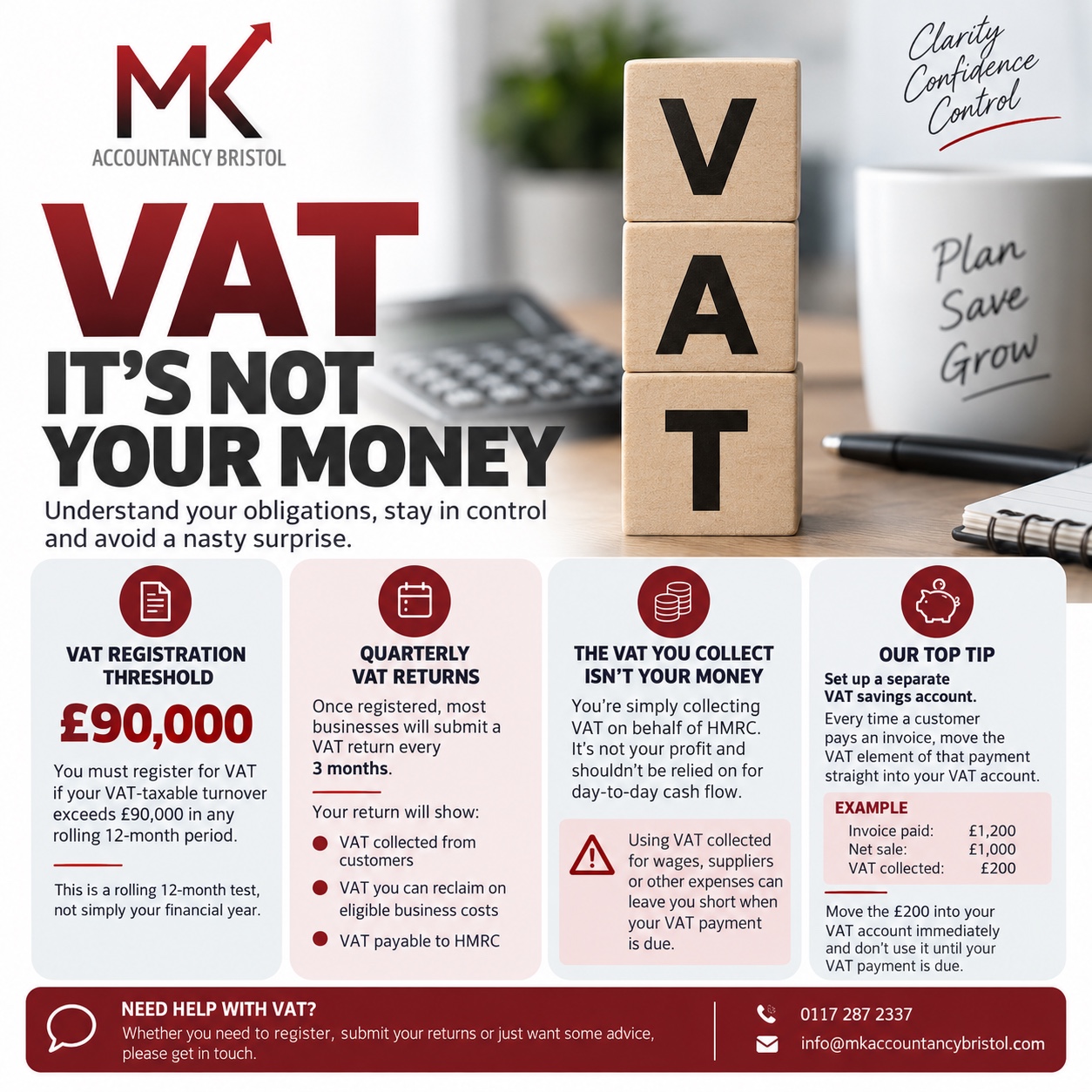
Most VAT-registered businesses submit a return every three months. The usual online filing and payment deadline is one calendar month and seven days after the period ends, although some schemes have different rules.
Your return reports VAT on sales and eligible reclaimable VAT on purchases, with the balance payable to HMRC or refundable to you. We can help with your records, return and deadlines.
VAT collected from customers is not your profit. Using it for everyday costs can leave you short when your VAT bill is due. A separate VAT savings account can help you keep the money available.
For example, a £1,200 customer payment for a standard-rated sale contains £1,000 of sales income and £200 VAT. Setting aside the £200 is a useful starting point; your final liability will also depend on eligible input VAT and your VAT scheme.
Yes. A correctly structured Relevant Life Policy can allow a company to provide life cover for an eligible director or employee. Premiums may qualify for Corporation Tax relief where they meet the business-expense rules, and the cover can normally be provided without a benefit-in-kind charge when the relevant conditions are met.
The policy is typically arranged in trust for the intended beneficiaries, rather than paying the benefit to the company. Tax treatment depends on the policy and individual circumstances. Simply paying an existing personal policy through the company can create tax and National Insurance charges.
We can discuss the accounting and tax position and introduce you to our partner, Trulife Financial, for advice on suitable cover. Ask us about Relevant Life cover →
HMRC: Relevant Life Policies →
View our Relevant Life guide →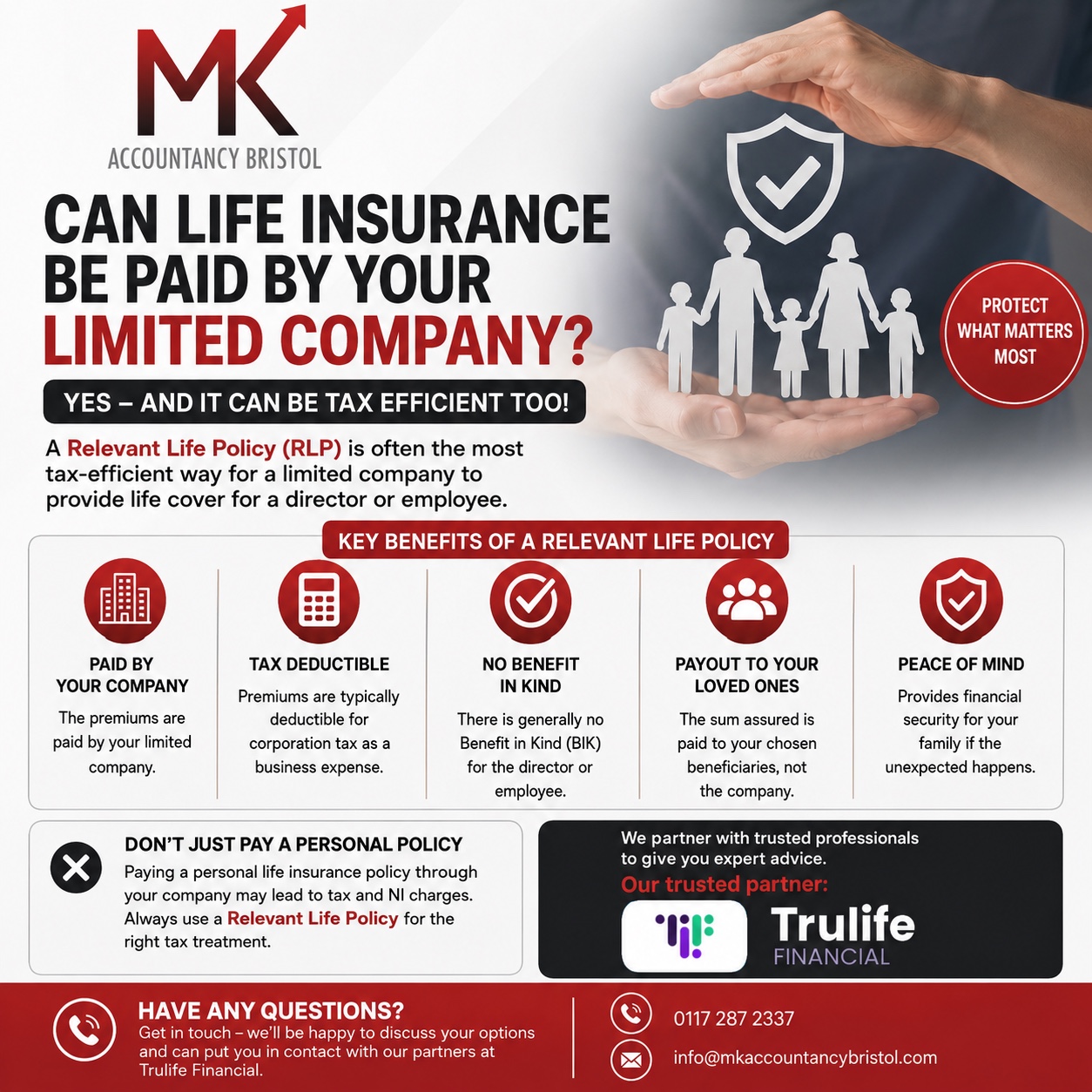
Yes, your limited company can pay for a director’s or employee’s gym membership. However, a commercial gym membership for personal use is normally taxable, so paying through the business does not automatically make it tax-free.
Where the company contracts with the gym and pays for the membership, it is normally a benefit in kind. It must be reported on a P11D or through an appropriate registered payrolling arrangement, and the company normally pays Class 1A National Insurance. The director or employee also pays Income Tax on the taxable benefit.
If the membership is your personal contract and the company pays the gym, different National Insurance rules apply. Reimbursing you personally is normally treated as earnings through payroll. It is worth checking the arrangement before you set up a Direct Debit.
The company may receive Corporation Tax relief where the cost forms part of a genuine remuneration package and meets the business-expense rules. A sole trader’s personal gym membership is not normally an allowable business expense.
We can check the overall tax cost and reporting requirements before you decide. Ask us about company-paid benefits →
HMRC: club membership and reporting →
View our gym membership guide →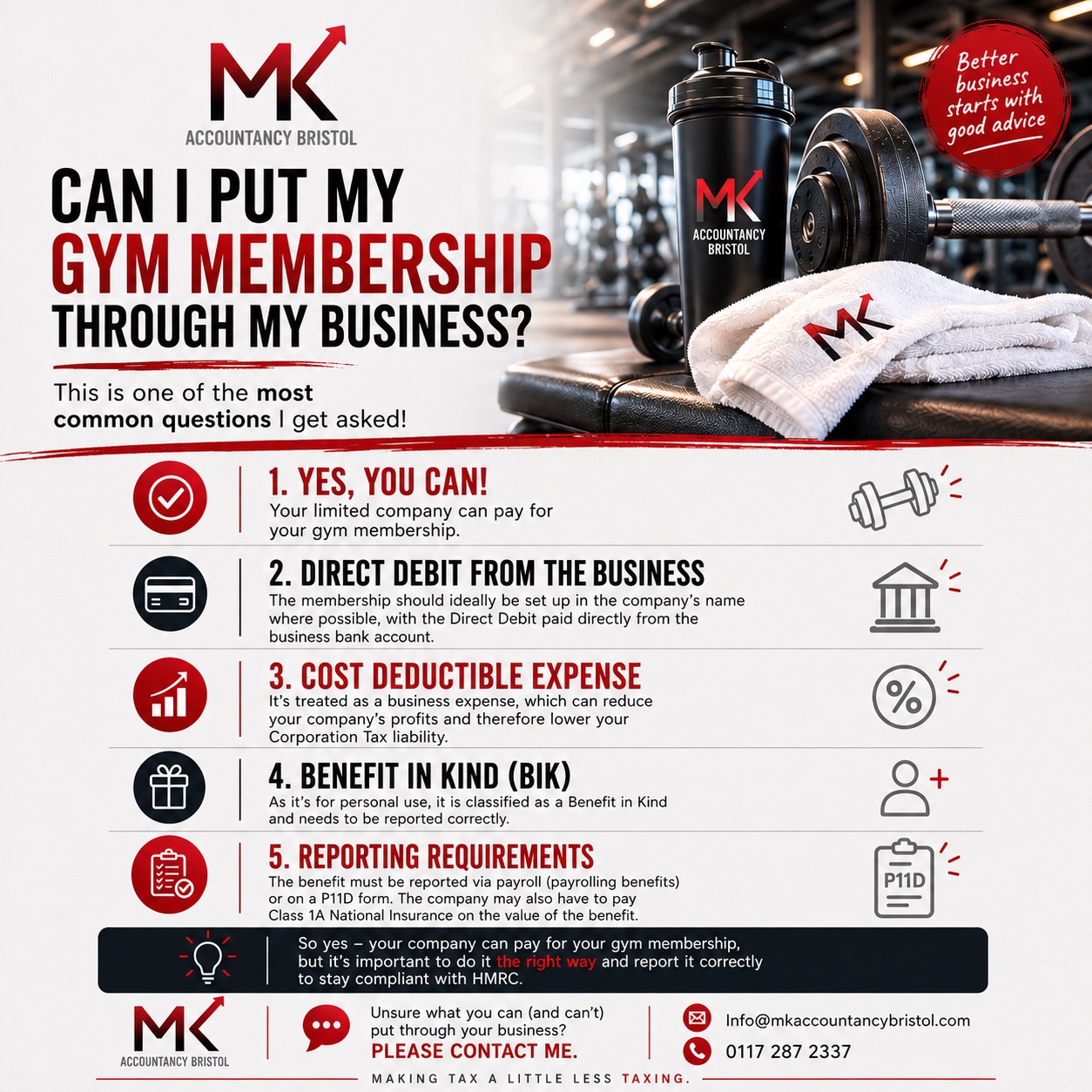
For employees and directors using their own vehicles for qualifying business travel, HMRC’s approved rates for 6 April 2026 to 5 April 2027 are:
| Vehicle | First 10,000 miles | After 10,000 miles |
|---|---|---|
| Car or van | 55p per mile | 25p per mile |
| Motorcycle | 24p per mile | 24p per mile |
| Bicycle | 20p per mile | 20p per mile |
These rates cover the use of your own vehicle; company cars have separate rules. Payments above the approved amount may be taxable. Keep a mileage log showing the date, business purpose, journey and miles. Ordinary commuting does not normally qualify.
HMRC: approved mileage and passenger rates →
View our 2026/27 mileage guide →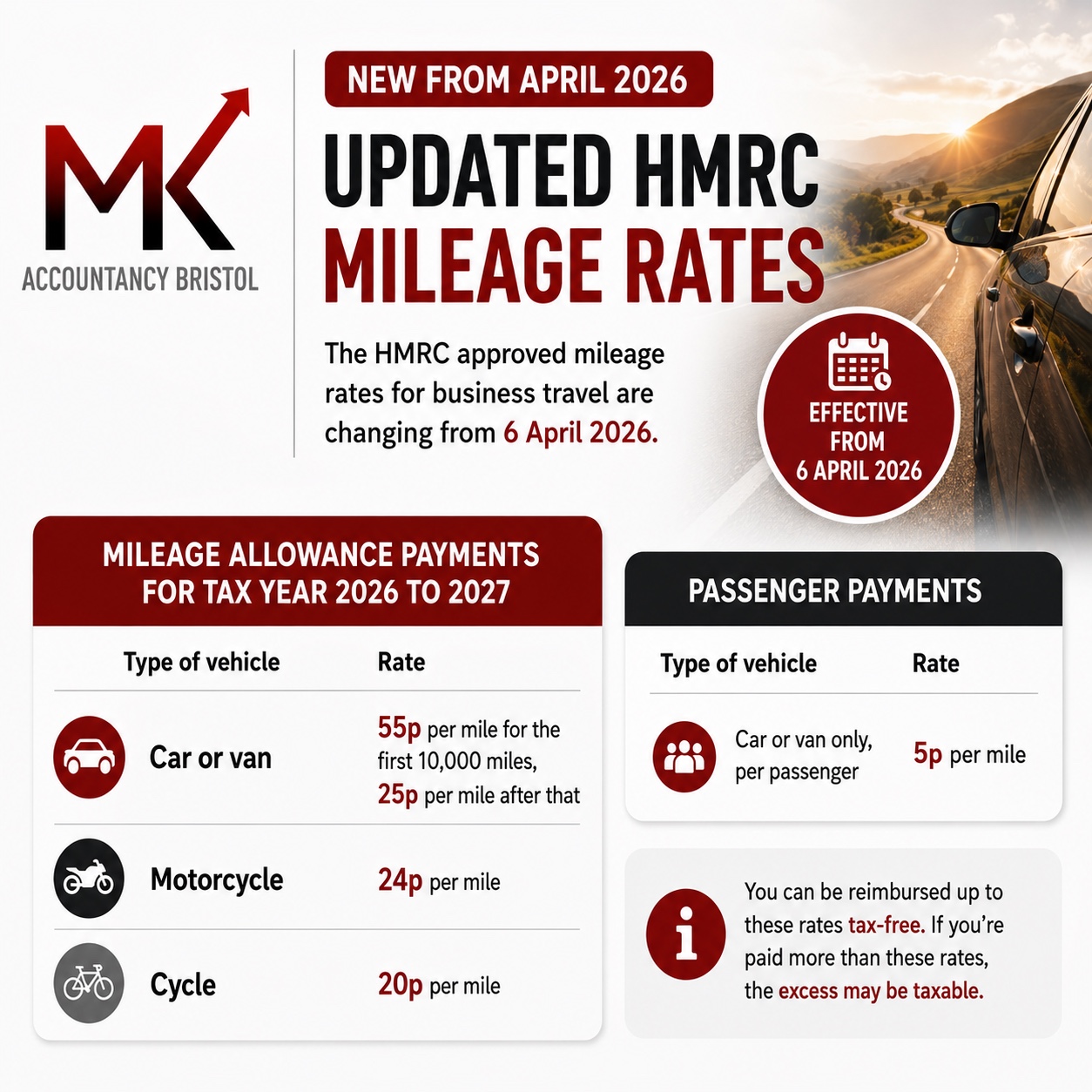
An employer can pay an additional 5p per business mile for each fellow employee you carry in your own car or van, provided the journey also qualifies as business travel for that passenger. It does not apply simply because a family member or friend comes along.
Record the passenger’s name and the business reason for the trip alongside your mileage log.
Tax information checked 13 November 2026. General guidance; we’ll confirm how the rules apply to your circumstances.
05 / YOUR NEXT CHAPTER
Tell us a little about yourself and what you’re looking for. We’ll take it from there.
Info@mkaccountancybristol.com →0117 287 2337Bristol, United Kingdom